Vietnam claims Asia’s top position in branded residences as luxury supply surges
C9 Hotelworks’ newly released Asia Branded Residences Market Review 2026 shows Vietnam leading Asia’s USD40-billion branded residence market with 20% of the region’s total value
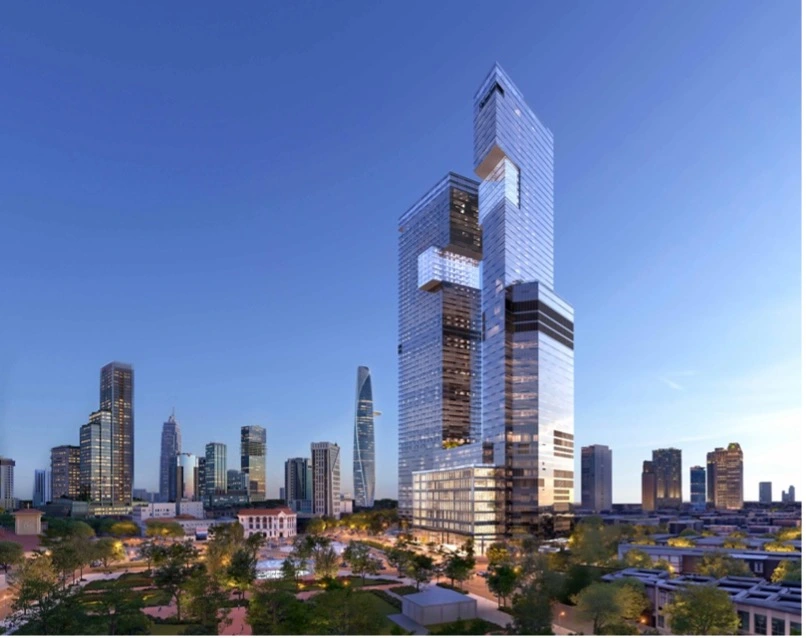
Vietnam’s branded residence sector has soared over the past year, becoming the largest market in Asia’s USD40-billion branded residence industry by value, according to the recently released Asia Branded Residences Market Review 2026 by C9 Hotelworks.
Many of the world’s leading hospitality and lifestyle brands are rapidly capitalising on a booming economy and thriving travel industry to introduce world-class projects across the country—from dynamic gateway cities to emerging coastal regions—including the launch of One Central Saigon in the second quarter of this year, which houses the Ritz-Carlton Residences.
These are among the key findings from leading Asia branded residence specialists C9 Hotelworks, which reveals that Vietnam’s branded residence sector is now worth VND 211.2 trillion (approximately USD8 billion), representing 20% of the regional total. This exceeds Thailand (USD6.4 billion) and South Korea (USD5.8 billion), with these top three countries accounting for more than half of Asia’s overall value.
“Vietnam’s rise as a regional hub for travel, hospitality and branded real estate has been remarkable,” says Bill Barnett, managing director of C9 Hotelworks. “The accelerated expansion and modernisation of the country’s infrastructure has been the catalyst for widespread investment and development, which has resulted in a huge supply of new residences in urban and resort destinations.”
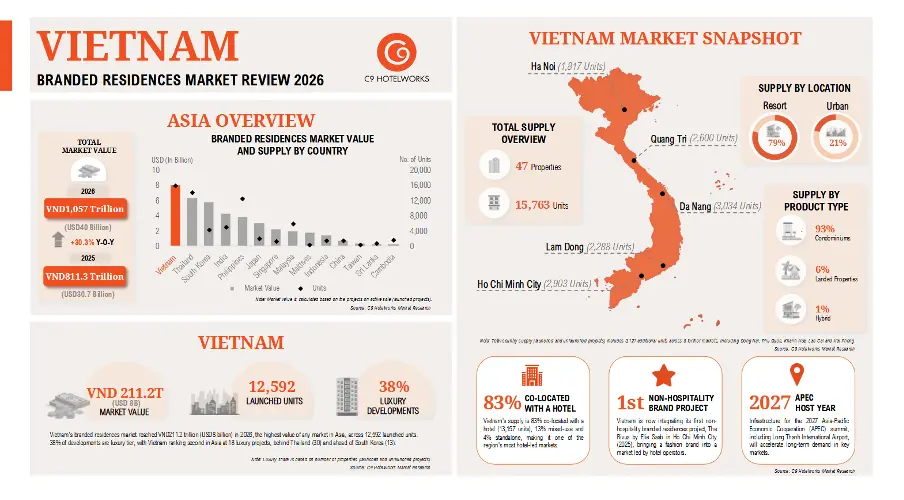
The fast pace of branded residence development in Vietnam is evidenced by the size of the country’s construction pipeline. In terms of launched projects, Thailand is the largest market in Asia with 13,124 units (compared to 12,592 in Vietnam). But when pipelines are taken into account, Vietnam leads the way with 15,762 units (launched and unlaunched) across 47 projects.
The fact that Vietnam commands the highest overall market value also reflects that its supply is concentrated in the upscale and luxury tiers, which drives up average values. More than a third (38%) of total projects are in the luxury segment.
Interestingly, 83% of Vietnam’s branded residences are co-located with a hotel, while a further 13% are in mixed-use developments and only 4% are standalone projects. This hotel-driven environment aligns with the fact that Vietnam has one of the world’s largest hotel pipelines, spurred on by record-breaking tourist arrivals. But non-hospitality brands are also starting to take notice; The Rivus by Elie Saab opened its doors in Ho Chi Minh City in 2025, becoming the country’s first residence from an international fashion house.
Vietnam’s branded residence surge spreads across the country, from north to south. The key cities of Da Nang (3,034 units) and Ho Chi Minh City (2,903) lead the way, while the capital Ha Noi (1,817) is fourth. There are other notable growth zones, including Quang Tri (third place, 2,600), a resort destination on the north-central coast, and Lam Dong (fifth, 2,288) on the southeast coast, where large-scale developments by Wyndham and Accor are driving expansion. With a further 3,121 units across eight other markets, including Dong Nai, Phu Quoc, Khanh Hoa, Lao Cai and Hai Phong, Vietnam’s branded residence boom is a nationwide phenomenon.
Related: Thailand’s branded residences market tops THB205 billion
With a surge in stock, the question of sales and marketing is a key issue, one described by Bill Barnett as an “unresolved question” for many developers.
“It’s a key issue and a process that is often misunderstood. Marketing and sales strategies for branded residences are fundamentally different from traditional real estate,” comments David Johnson, CEO of Delivering Asia, Asia Pacific’s leading marketing advisory for branded residential developments.
“Developers need to focus on building a narrative architecture, market positioning, and an integrated communications programme to drive desirability, buyer engagement, and sales performance if projects are to be successful.”
The surge of new branded residences is just one example of the broader development that is sweeping Vietnam. As the host of the APEC Economic Leaders’ Week in 2027, Vietnam is accelerating its preparations with significant infrastructure upgrades. From the soon-to-open Long Thanh International Airport to the planned high-speed railway between Ha Noi and Ho Chi Minh City, a network of new highways and state-of-the-art attractions, Vietnam is improving connectivity and establishing itself as a regional hub for leisure travel, business events, relocation and investment.
Click here to review the Asia Branded Residences Market Review 2026.
About Bill Barnett
 Bill Barnett — a globally recognised hospitality, tourism, and real estate advisor — is the founder and managing director of Asia-based C9 Hotelworks and esteemed member of the PropertyGuru Asia Property Awards (Greater Niseko) Judging Panel.
In addition to being a leading consultant, he is a frequent speaker at industry events and conferences. With over 30 years’ experience in the Asia Pacific region, he has an extensive background in hotel operations, development, and asset management. His past employment highlights include Senior Corporate roles at international hotel chains and publically listed companies. Bill is considered to be one of the foremost industry experts in the hotel residences sector. To date, Bill is the author of four books on travel, property, and hospitality under the titles of Slave to the Bean, Collective Swag, It Might Get Weird and Last Call.
Recommended
Opportunity or trap? What Washington’s high-tech hub outside Manila means for Philippine property
The New Clark City Economic Security Zone promises billions in investment, but at what cost to Philippine sovereignty?

What Japan’s policy rate hike means for its property market
After decades of near-free borrowing, the country's policy rate is starting to reshape the calculations behind property investment

A conversation with the head of Vietnam’s Green Building Council on the cost of doing nothing
The VGBC’s Douglas Snyder argues that the real cost developers should fear isn’t building green. It’s failing to do so

These 6 projects are among Asia’s greenest in 2026
Proof that better buildings are defined as much by how they operate as how they look