How China builds its cities twice, first in data and then in concrete
The country is increasingly focused on deploying digital twins of cities and urban districts to manage everything from traffic flow to population density
When the Chinese government announced Xiong’an in Hebei province in 2017 as a new city to ease pressure on Beijing, the local property market surged almost overnight. Buyers flooded into the semi-rural wetlands and smallhold farms 100 kilometres southwest of the capital, pushing prices up by 400% within months and prompting swift government curbs on speculation.
The frenzy was sparked by just eight Chinese characters: “Millennium plan” (qian nian da ji), described in the official announcement as “a matter of historic national importance” (guo jia da shi). At the time, the meaning behind the phrase was left deliberately vague.
By 2018, official planning documents described Xiong’an as “a high-level socialist modern city.” A year later, the state news agency Xinhua labeled it “a city of the future.” By the early 2020s, it had acquired a new identity: a “digital twin city.”
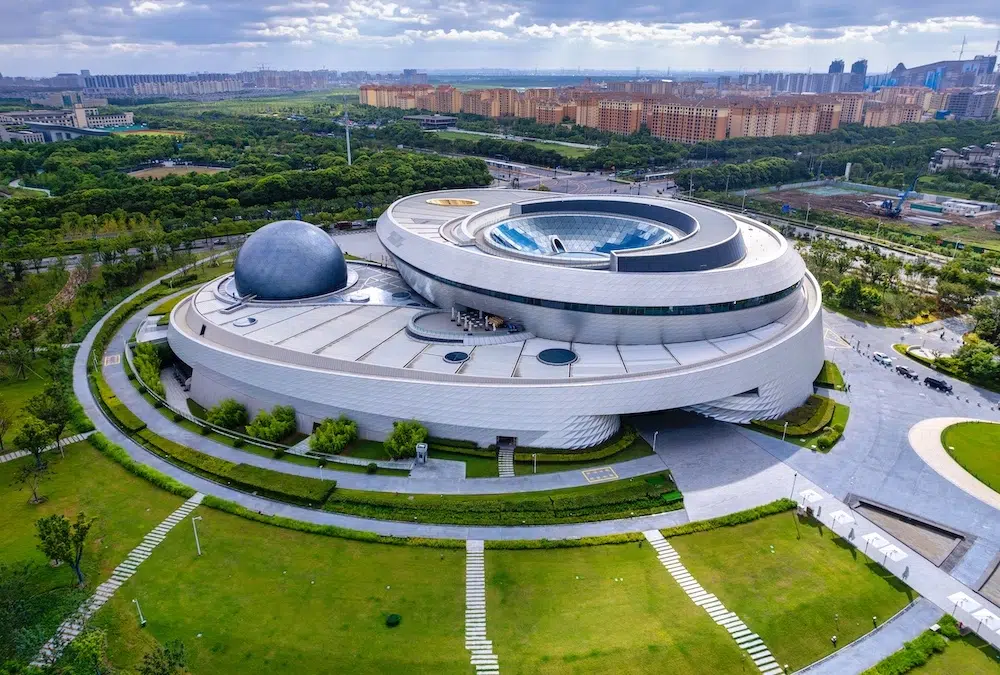
As the first city to see its physical and digital versions developed in parallel, Xiong’an is widely seen as China’s flagship digital twin project. Since then, others, including Shanghai’s Lingang district, have followed suit, building data-heavy digital models to simulate and test urban systems before real-world implementation.
Applications span engineering, architecture, traffic management, and urban planning. Yet adoption within the real estate sector remains limited, raising questions about when digital twin technology will move into mainstream property use, both in China and globally.
More than six years ago, digital twin cities were already a major talking point at industry conferences in China, says James Macdonald, head of research at Savills in Shanghai. But their impact on real estate has been modest.
Related: How China became the testing ground for Zaha Hadid Architects’ boldest ideas
“Cities such as Xiong’an are often cited as pilot projects, but practical applications are still evolving,” he says. “Most traction remains at the smart city or government level, rather than in day-to-day real estate development or investment.”
Despite the broader industry nearly doubling to USD3 billion between 2020 and 2025, real estate accounted for less than 3% of spending on digital twin technology, according to the China Business Industry Research Institute.
At the policy level, however, adoption has been decisive. Digital twin technology was elevated to a national priority in 2021, and by late 2023, a government white paper outlined a future in which AI and digital twins converge to create “self-adaptive” or semi-autonomous cities.
The shift from smart systems to full digital twins is largely a matter of integration—connecting disparate data streams into a unified control platform
In practice, many cities in China and beyond have already laid the groundwork. Smart city systems now monitor utilities, traffic signals, and parking infrastructure, forming the building blocks of more advanced digital twin platforms.
“In that sense, places like Xiong’an and Lingang are less outliers than indicators of where policy is heading,” says David Tingxuan Zhang, a macroeconomics and policy analyst at Trivium China.
The shift from smart systems to full digital twins is largely a matter of integration—connecting disparate data streams into a unified control platform.
“Smart cities have gained traction because there is real demand,” Zhang adds. “China is moving away from expansion-led real estate growth towards urban renewal and retrofitting.”
Where this leaves the property sector is less clear. The ongoing real estate downturn—marked by developer defaults, restructuring, and tighter controls on speculation—has dampened both private investment and confidence.
Some major developers have begun incorporating elements of digital twin thinking into internal processes, particularly in design optimisation, cost management, and operations, Macdonald notes. “But adoption is far from widespread.”
Artificial intelligence may prove to be the catalyst. As companies such as DeepSeek gain global traction and AI usage becomes embedded across Chinese society, the potential for digital twin applications is becoming more tangible.
By December 2025, China had more than 600 million generative AI users, according to the World Internet Conference—a rise of over 140% in just one year. Roughly one in two Chinese citizens now use AI regularly, compared to one in five globally.
This rapid uptake suggests China could become a leading adopter of digital twin technology in real estate. For now, however, that shift remains hypothetical.
“Digital twin cities are increasingly discussed and piloted,” says Macdonald. “But there is still a gap between concept and application—though that gap may narrow as technology and regulation evolve.”
This article was originally published on asiarealestatesummit.com. Write to our editors at [email protected].
Recommended

A conversation with the head of Vietnam’s Green Building Council on the cost of doing nothing
The VGBC’s Douglas Snyder argues that the real cost developers should fear isn’t building green. It’s failing to do so

These 6 projects are among Asia’s greenest in 2026
Proof that better buildings are defined as much by how they operate as how they look
Indonesia’s property market feels the pinch of a reeling rupiah
As Jakarta tightens its grip on strategic minerals, investors are fleeing, leaving the property sector in limbo

Japan’s cities boom as rural towns hollow out
Millions of homes sit abandoned as the forces reshaping Japan's property market pull in opposite directions