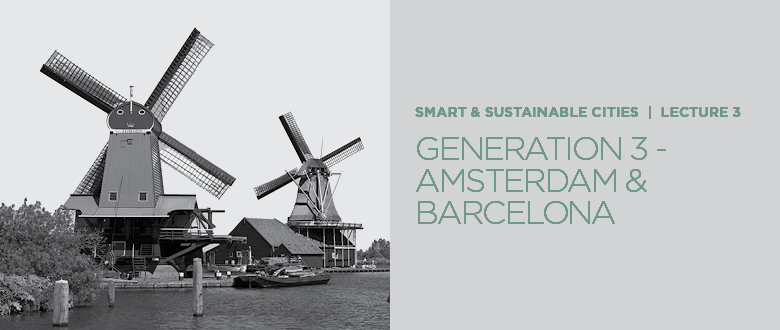
Smart and sustainable cities: lecture 3
When one thinks of what a Smart City is, the natural inclination would be to a Utopian (or dystopian) vision — largely based on technology — specifically Information and Communication Technology (ICT) and the Internet of Things (IoT). It imagines a future where lives are made easier and more productive — thanks to technology. However, it is easy to overlook the important roles governance, culture and community play in enabling smart practices to take place. Furthermore, as the needs of the city dwellers around the world vary, so too do definitions of what makes a Smart City.
In this three part lecture series, we consider three generations of Smart City case studies from around the world — investigating their unique characteristics and key smart innovations and design principles, and ultimately ask whether such environments really enhance our daily lives. In this third and final lecture of the series, we investigate Third Generation Smart Cities, Barcelona and Amsterdam.
To view the video, please visit pomeroyacademy.sg/course/smart-and-sustainable-cities-lecture-3/. Watch the first and second parts here
Recommended

A conversation with the VGBC’s executive director on the risk of not building green
The Vietnam Green Building Council's Douglas Snyder argues that the real cost developers should fear isn't building green

These 6 projects are among Asia’s greenest in 2026
Proof that better buildings are defined as much by how they operate as how they look
Indonesia’s property market feels the pinch of a reeling rupiah
As Jakarta tightens its grip on strategic minerals, investors are fleeing, leaving the property sector in limbo

Japan’s cities boom as rural towns hollow out
Millions of homes sit abandoned as the forces reshaping Japan's property market pull in opposite directions